Who Lived in Your Union County House? Start at the Courthouse
November 26, 2026
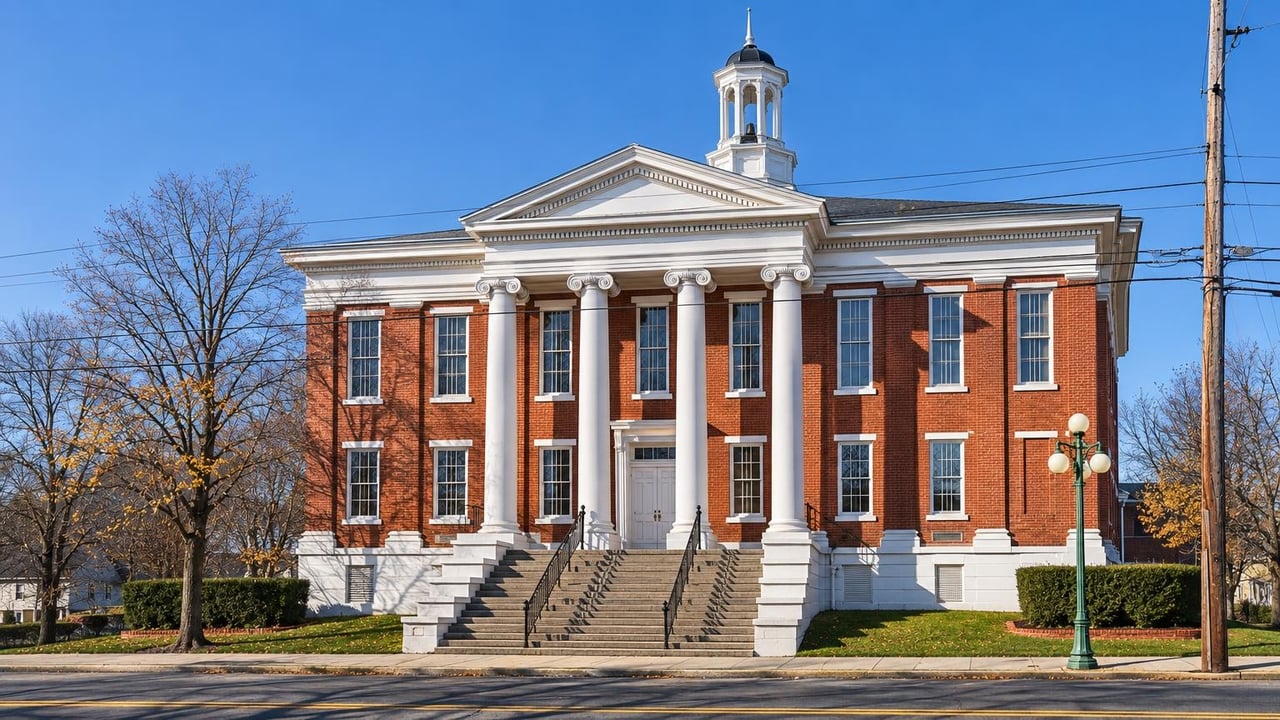
In 1798 the federal government taxed houses, and the assessors walking what is now Union County wrote down more than owners' names. The Direct Tax of 1798 for Northumberland County covered present-day Union and Snyder counties. It recorded property owners, tenants, a description of each property, descriptions of the buildings and what they were worth. A copy of that record is on the first floor of the Union County Courthouse in Lewisburg. You'll find it in the office of the Union County Historical Society, along with most of the other records you would need to work out who built your house and who lived in it.
That office is the most useful place in the county for a homeowner who is curious about an old house. Its collection lines up with your house's past in layers. Each layer gives you a name or a date, and that name or date takes you to the next layer down. Here is the order to work in, starting with the most recent records.
Begin with records from living memory. The society's office lists local phone directories for 1899, 1901 and 1910, and then a continuous run from 1944 to 2012. A sixty-eight-year stretch of directories lets you look up your address one year at a time. You can see when a family moved in, when the listing changed to a widow's name, and when new owners took over.
With those names in hand, check the census. The office holds microfilmed Union County census records from 1820 to 1903. The 1900 to 1930 censuses it lists record whether each household owned or rented, along with every household member's occupation and place of birth. For a Lewisburg rowhouse or a Mifflinburg double, the owned-or-rented column often shows when a house went from a landlord's property to a family's home.
Newspapers fill in the details. The society has the Lewisburg Chronicle on microfilm for 1847 to 1912. It has the Mifflinburg Telegraph for 1862 to 2002, except for the years 1868 to 1872. The society also keeps a collection of newspaper articles called "Once Upon A Time" and publishes an online local-history journal, Accounts of Union County History. The society says the article collection covers properties as well as people, families and businesses. Search both for your street before you spend an afternoon at a microfilm reader.
Fire insurance maps are where most house histories get interesting. In the late 1800s and early 1900s, the Sanborn Map Company mapped towns so insurers could judge fire risk. The society notes that its sheets mark streets, utilities, and whether each structure was log, brick or frame.
If you live in Lewisburg or Mifflinburg, you can start these at home tonight. Penn State University Libraries' Digital Map Drawer has seven Lewisburg editions online: 1885, 1890, 1896, 1901, 1906, 1913 and 1925. For Mifflinburg it has 1887, 1896, 1906, 1913 and 1926. Penn State says its Hamer Center holds a nearly complete set of Pennsylvania Sanborn maps and keeps adding digitized sheets as they come out of copyright.
The courthouse office picks up where the online maps stop. The society lists its Mifflinburg Sanborns as running from 1887 to 1943. That gives Mifflinburg homeowners about seventeen more years of sheets than Penn State has online. Those years matter if your house went up in the late 1920s or 1930s.
Compare the editions in order. A footprint that shows up between two editions gives you a construction window. A small frame addition at the back of a brick house that appears in one edition and not the one before dates the kitchen wing. A lot that changes from log to frame tells you something was replaced. Lewisburg's run is long enough to show this kind of change. The Lewisburg Downtown Partnership counts 871 contributing buildings, structures and sites in the borough's National Register historic district, which covers most of the borough and much of the Bucknell campus. Many of those buildings appear on sheet after sheet across forty years of Sanborn maps.
Before the Sanborns, there are county maps. The Library of Congress has a free online copy of the 1856 Map of Union County. Its catalog says the map names rural householders and has borough insets with lot lines, lot numbers and buildings for Lewisburg, Hartleton, New Columbia, Mifflinburg and New Berlin. The Pennsylvania State Archives lists the same year's Union County map as its map #21 and describes its 1850s to 1870s county maps as showing property owners and dwellings.
For a farmhouse out in Buffalo, Kelly, West Buffalo or Hartley township, the Sanborn editions listed above cover only the boroughs, so the 1856 map is the first map to check. A surname printed on the road your house sits on gives you a name to look up in the tax rolls.
Twelve years later came the 1868 Atlas of Union & Snyder Counties, which runs 67 pages. Penn State's index of early Pennsylvania county maps and atlases links to a scan of it. The same index lists a Union County manuscript map from around 1817. Comparing the 1856 map with the 1868 atlas can show whether a farm changed hands during the Civil War years.
The oldest layer is back at the courthouse office, and it is the hardest to find anywhere else. The society holds tax assessments for Union and Snyder counties from 1792 to 1881. Those rolls record occupations, property ownership, livestock, whether a man was single or a tenant, and widows who owned property. Following one owner's name from year to year shows when that person first appears as a property owner.
The trail ends at the 1798 Direct Tax and its building descriptions. The society also holds agricultural censuses for 1850, 1860, 1870 and 1880, which show what individual farmers were raising. If the tax rolls give you the name of the farmer who owned your Mifflinburg-area or Millmont-area farmhouse in 1860, that year's agricultural census shows what the farm was raising.
The society's own farm shows how far back these records can go. The Dale-Engle-Walker house at 1471 Strawbridge Road was left to the society in 2001. Samuel Dale, a Scots-Irish immigrant, bought the 137-acre farm in 1785. Within eight years a four-room limestone house stood in front of the original log cabin, which had been built about twenty years earlier. The society restored the house, dated to about 1793, to interpret the county's farm history. The site also has the restored Engle dairy shed, a replica wagon shed, and the Milne log cabin from about 1789, which was moved onto the property in 2019. A stone house dated to about 1793 is the kind of building those assessors were describing.
The office is on the first floor of the courthouse at 103 South 2nd Street, Lewisburg, one floor up from the ground-floor entrance. The society asks you to send your question before you visit or send payment, so staff can have material ready. Posted hours are Monday, Tuesday and Thursday, 9 a.m. to 3 p.m., closed from noon to 1 p.m. The homepage asks visitors to call or email first, at (570) 524-8666 or [email protected].
Members use the library free, and the society asks nonmembers for a $5 donation. If you would rather hand off the work, the posted rates include $75 per surname for a general genealogy search, $5 for an obituary search and copy, and 50 cents per copied page. The 2025 membership form lists annual levels from $50 to $200 for adults and $10 for K–12 students. Members get free library use, several newsletters a year and a free biennial Heritage publication. The society also welcomes donations of family histories and photos of identified Union County people and places. If you find an old photo of your house in a drawer, it could go to the archive once you've made a copy.
The society's programs run out of its Gallery at 15 N. Water Street, in the Annex it bought along with the former Packwood House in 2023. The society describes the Packwood building as a planned future Union County Museum. The next talk on the calendar is "The D-Day Invasion of 1944: Reviewing History from England to France," presented by Mike Molesevich. It's listed for Sunday, December 13, 2026, from 2:30 to 4 p.m., and admission is free. If you stop by that afternoon, you can ask staff about scheduling a weekday research visit.
The questions these records answer are the same ones we ask when we value an older home: when the house was built, what it was built from, and what has been added since. If you've traced your house back to a Sanborn sheet or a line in the 1798 tax and want to know what that history means for its value today, CENTURY 21 Mertz & Associates and our in-house team at Susquehanna Valley Appraisal Services are glad to walk through it with you. You can start with a free home valuation or browse our Union County page.

Connect with CENTURY 21 Mertz & Associates today to explore homes, investment opportunities, and expert guidance in Danville and Lewisburg. Let our local team help you achieve your real estate goals.